

TLDR:
Keyword research rests on four pillars: idea generation, analysis, planning, and prioritization. Carry out each step correctly and you will end up with a structured list of keywords that you need for your SEO campaign. For beginners, the motto is to focus on what matters most and work close to the result.
Intro into Keyword Research
Before you start your keyword research, let's clarify some fundamental questions so you can follow this guide as effectively as possible. If you already have some initial SEO experience, you can scroll directly to the next section.

What are keywords?
Keywords are search terms (also called key phrases) that users employ to search for information in search engines.
What types of keywords are there?
There are two important types of keywords. Short-tail keywords are usually unspecific and have a high search volume. Long-tail keywords are generally specific and have a lower search volume. Long-tail keywords are often an opportunity for beginners to rank for topically relevant search queries without facing strong competition.
What is keyword research?
Keyword research is a practice from search engine optimization (SEO) in which search terms are analyzed. Based on the results, companies create content that meets consumer demand.
What are the criteria for good keywords?
Good keywords share a combination of high demand, proximity to the buying process, and low competition. We will show you how to find such keywords further below in the text.
What are search intents?
Search intents are the underlying motivations a user has when making a search query. There are three main categories: informational, navigational, and transactional search intents. How search intent influences your keyword research will be covered later in this guide.
Finding Keyword Ideas
You want to create content for potential customers but don't know what they're searching for? This is a problem everyone faces when first getting into SEO.
Your keyword research therefore starts with one key question: "What does my customer actually want?"
The answers serve as the foundation for the actual keyword research. For researching and evaluating individual search terms, you can use so-called SEO tools to find the ideal keywords using various metrics. The prerequisite is that you are familiar with your subject area in order to make well-informed decisions.
Brainstorming and Seed Keywords
Think of terms that come to mind related to your topic. Grab a pen and paper — or an Excel spreadsheet — and just start writing. Everything that comes to mind is potentially important.

For example — let's say you sell hiking boots and care products. With a little thought, you might come up with the following terms:
Hiking boots
Trekking boots
Beeswax
Admittedly, these aren't particularly creative terms, but they form a solid starting point. We call these search terms seed keywords.
Seed Keywords
Seed keywords are terms we have established as a basis before our research begins. Our later research is built around them. You should therefore invest a minute more rather than less in selecting these keywords.
Ask yourself the following questions to optimize your brainstorming:
What is the name of your product or service?
What did you search for to find your product or service?
Who searches for your product or service?
What are synonyms for your product or service?
What terms are related to your product or service?
Write down one to five answers for each question. These answers are your seed keywords.
Google Search
Got your first ideas written down? Great!
Now open the best SEO tool of all — the Google search engine.
Your goal is to expand your seed keywords with additional terms using Google's autocomplete feature. The advantage of Google is that you'll find exactly the search queries that your potential customers are actually making.
Start by searching for one of the terms you noted down earlier. In our case: "Trekking boots."
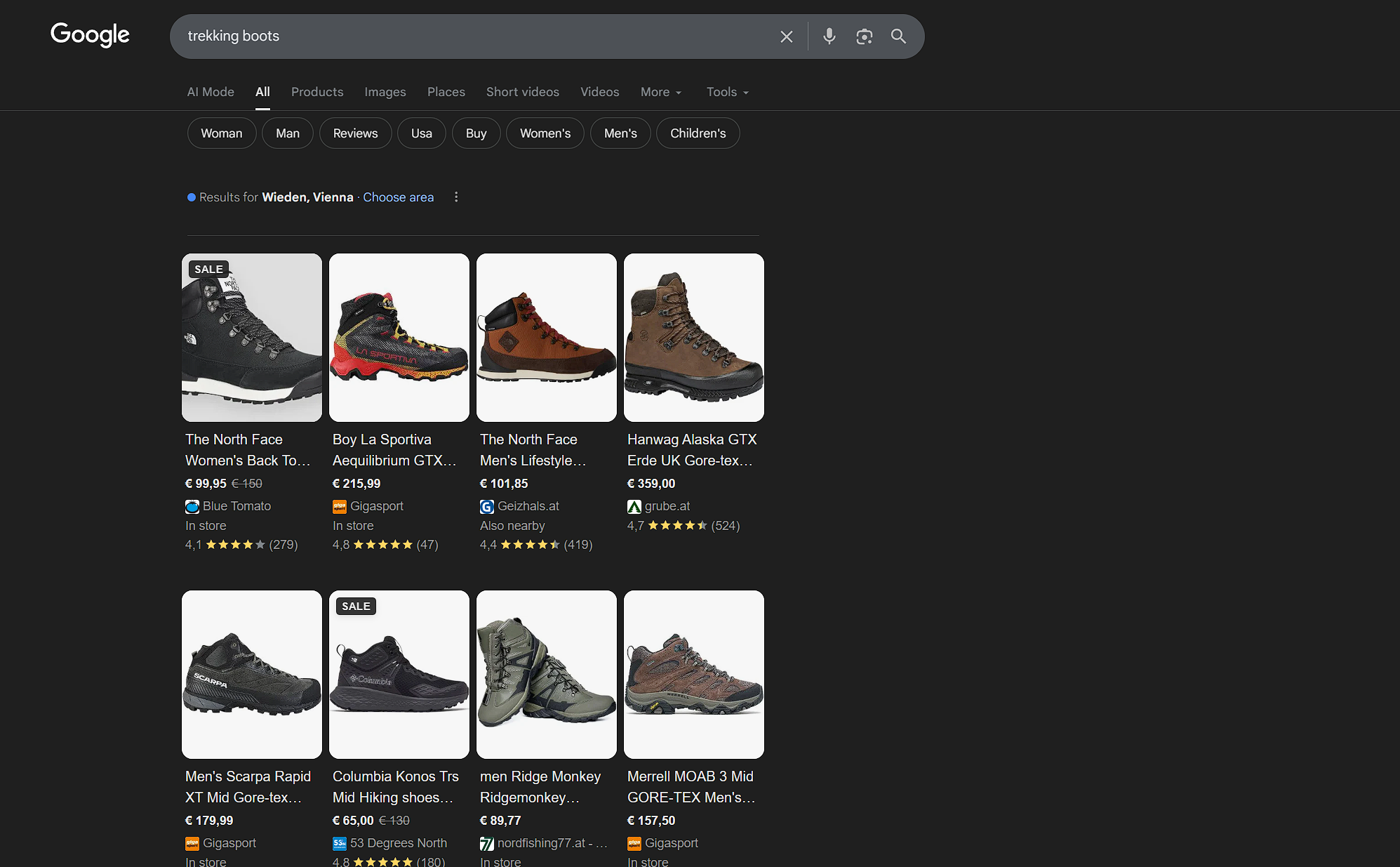
Take a look at the first results. Are the websites similar to your own? If so, that's a good sign. If not, you can continue finding search terms using Google Auto-Suggest. Simply add a space before or after your seed keyword.
The new terms are usually LTKs (long-tail keywords), as they are more specific and consequently receive less traffic. For you, however, LTKs are a real opportunity, as the competition is generally lower than with short-tail keywords.
In addition, commercial search intents are frequently associated with LTKs. As a result, the value of a single visitor can be significantly above the niche average.
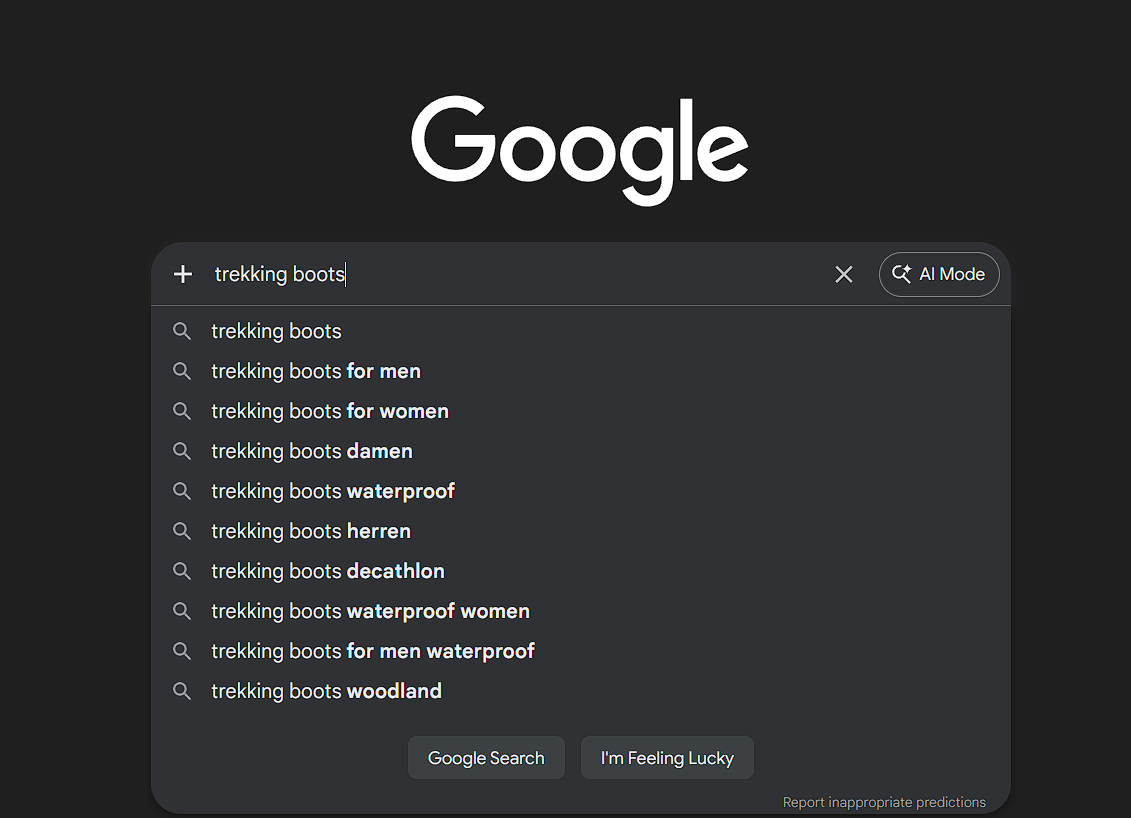
As you can see, Google suggests some search terms that didn't come up during brainstorming. You can use these suggestions and add them to your list of potential keywords.
Use additional search operators to get even more out of Google Search.
Competition
Take a close look at who is ranking for your seed keywords. Are they companies comparable to yours? It's important that you are competitive with the top results.
What does competitiveness mean in the context of SEO? Your offering should be similar. For example, if you want to rank for "trekking boots" and your competitor has 250 shoes in their range, while you only have 25, that's a bad sign.
In addition, your brand strength and domain authority should be comparable. If, for example, Meindl is ranking for the keyword "hiking boots," your chances with a newly created affiliate website for hiking boots are likely in the negative.
That doesn't mean you have no chance against large websites — quite the opposite. Many large websites, like Amazon or eBay, can be easily outperformed in specific niches. This is because Google favors experts and specialists in individual niches — many of the big websites, however, are generalists. Things get difficult when one or more strong specialists are among your competition.
Note
As a specialist and expert, you can even claim advantages in the search results over large companies that operate as generalists. To do this, Google must recognize you as a trustworthy source in your niche.
Therefore, consider whether you have a realistic chance of outranking your competitors within the top ten search results — if not, remove the relevant keyword from your list for now, or refine it into an LTK.
Social Media Platforms

In addition to Google, social media platforms like YouTube are the next largest search engines. Depending on your niche, you can find in-demand topics there. Our platform recommendations for idea generation are:
YouTube
Pinterest
Quora
Twitter
Instagram
Keyword Tools
You've already gathered a selection of keyword ideas. Now insert your seed keywords into a keyword tool. We'll walk you through the process using the SEO tool "Xovi" — you can set up a free trial account there to follow along with the next steps. If you're already using a different tool, that works too.
Keyword tools all work in fundamentally the same way. You enter a seed keyword and the software gives you a list of keyword ideas with additional metrics. Enter your keyword into Xovi's keyword analysis tool.
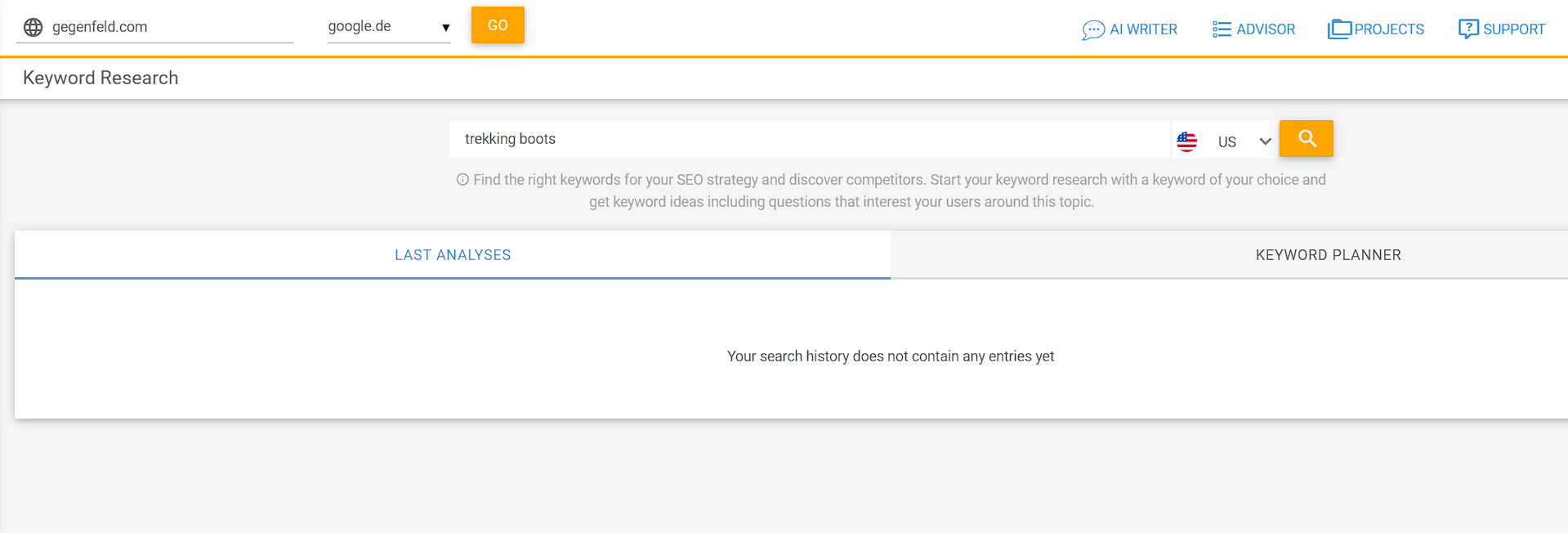
Click the Analyze button afterwards to receive matching keywords.
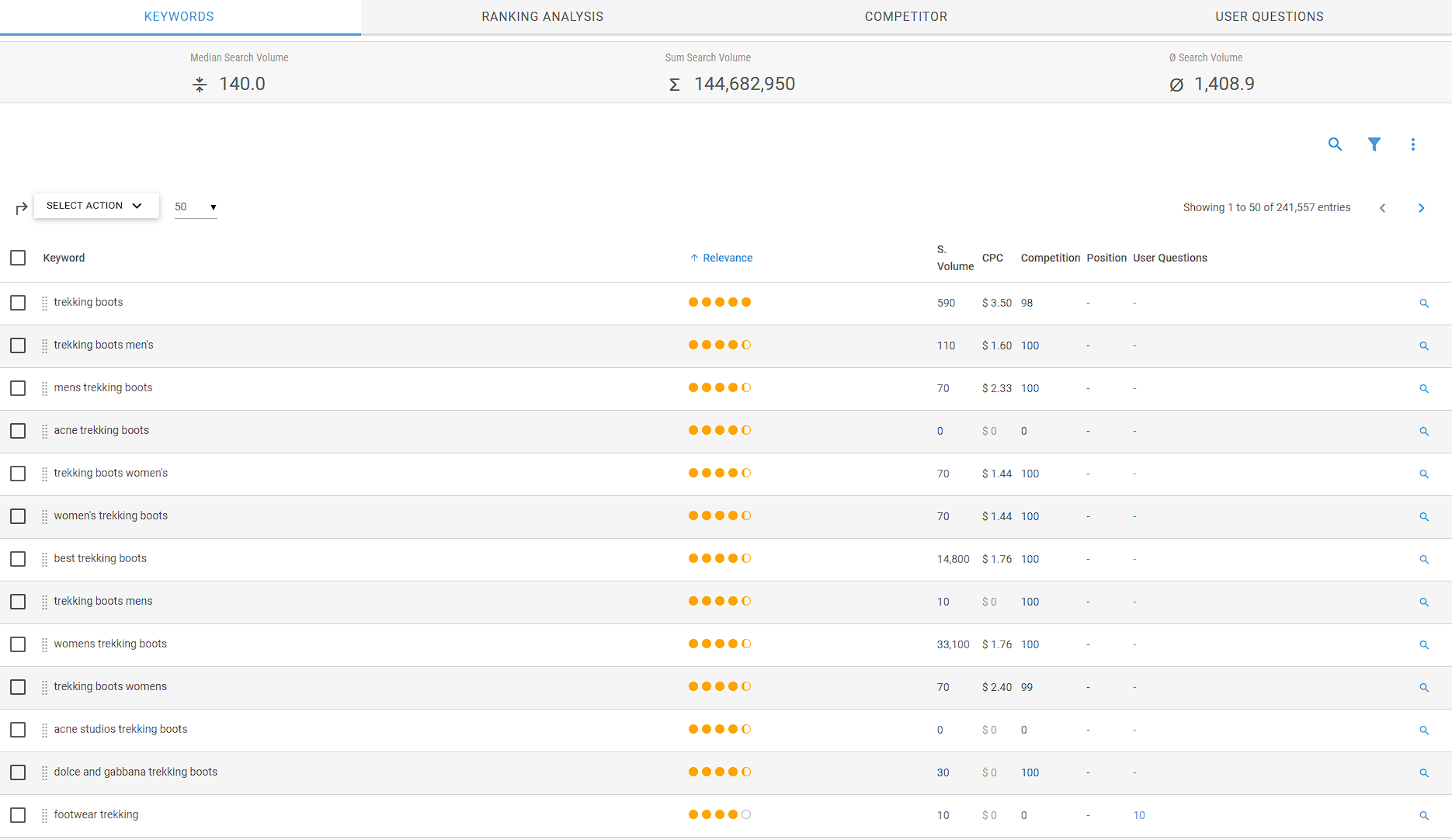
There it is — your new keyword list. Xovi was able to find over 2,950 matching keywords for our seed keyword "trekking boots." The new terms were evaluated according to the following metrics:
Relevance
Search volume
CPC
Competitors
Position
User questions
These metrics will become relevant again later when it comes to analyzing individual keywords. First, you need to know what to look for when carrying out an evaluation.
Keyword List and Focus Keywords
To prepare your keywords for analysis, export them in a CSV file. In Xovi, this can be done in just a few clicks. Select the three dots, click "Export," set the dataset size, and finally press "Export as CSV."
Save your list so you can carry out the analysis independently of the provider. If you switch your SEO tool in the future, or hand over your SEO work to a team member, a CSV file simplifies data sharing.
Additionally, later in this guide we will work with the keyword list to group individual keywords and sort them by certain parameters.
Focus Keywords
Focus keywords are the terms your SEO campaign centers on. For seed keywords and keyword ideas to eventually become focus keywords, you must study and analyze them thoroughly. How to determine whether a keyword is suitable as a focus keyword will be covered in the next step.
Conducting Keyword Analysis
Your keyword analysis is essential for identifying the right keywords for your SEO campaign. Read this section particularly carefully.
Search Intents
Search intent refers to the goal a user is pursuing with their search query. Google places great importance on a positive user experience. To achieve this, search results must always meet user expectations — and search intent is an important factor here.

When users find exactly the results they're looking for, they will continue using Google as their search engine in the future and consequently see Google's ads. That is why it is so important to Google and others that a search result matches the search intent.
In SEO, we distinguish between three categories that a search query can fall into. You can easily find out what a user wants by looking at the first three search results for a keyword. If the first results for the keyword "trekking boots" are all online shop category pages, it's likely that the user has purchase intent.
Consequently, you can only rank for "trekking boots" if you have a comparable online shop category page.
At the beginning of an SEO campaign, your focus should primarily be on commercial keywords that are close to conversion. These keywords have a transactional search intent.
Search intent is partly defined by the following criteria:
Type of keyword or specific words within the keyword
Type of ads in the search results
Type of websites in the top search results
Content type in the first three to five search results
Arrangement of Google search categories (Shopping, Images, News, etc.)
Type of Google snippets
Note that the search intent for a keyword can change over time. Here are the most common types of search intent.
Informational Search Intent
The user wants to receive information on a topic. Your goal is to provide the right information in the simplest possible way, while being as detailed as necessary.
An informational search intent can be identified by the following factors, among others:
W-questions (who, what, where, when, why, how) contained in the keyword
No product ads present
Wikipedia info box (right side) present
Q&A portals (such as Quora) are ranking
Guides, blogs, glossaries, or similar content types are ranking
If you notice that several of the above points apply, your keyword is likely associated with an informational search intent. Keywords with this intent generally receive the most traffic. Nevertheless, we advise you to rank your commercial pages (product, pricing, service, and category pages) first. Typically, the transactional (commercial) search intent is relevant for this.
That said, keywords with an informational search intent help you rank guides, blogs, or similar page types that are discovered by potential customers early in the customer journey — for example, during research on topic XYZ.

In our example, this could be a guide on trekking trips, where we can establish a first point of contact with potential future customers. This creates an early touchpoint with our company, building trust with the user.
However, this involves a great deal of effort that won't bring you direct revenue. You should therefore focus on the next type of search intent at the beginning.
Transactional Search Intent
Transactional search intents are essential for you if you are selling a product or service online. But local businesses, such as a carpentry shop, also benefit from this type of intent. Your goal is to rank first for keywords with transactional search intent.
The great advantage? Your website ranks where potential customers are actively searching for your offer. This allows you to increase your sales and raise the value of your traffic.
You can often identify a transactional search intent by the following criteria:
Distinctive words (such as "buy," "review," etc.) contained in the keyword
Product ads present
Google Shopping suggestions present
Online shops, marketplaces, or service providers are ranking
Product, service, or category pages are ranking
Keywords with a transactional search intent will make up the majority of your SEO revenue. Therefore, carry out your keyword analysis with extreme care. Allocate substantial resources to keywords in this group — it's worth it.
Navigational Search Intent
The third type of search intent is more relevant for established brands. With navigational search intent, the user is generally searching specifically for a URL/page, brand, or similar content. You can identify a navigational search intent by the following points:
Brand name, location, person, or similar contained in the keyword
Ads from the relevant brand present
Multiple search results from the same website present
The keyword is contained in the domain of the first search result
About us pages, homepages, or similar pages are ranking
Unless users are searching directly for you, you will have difficulty ranking for keywords with this intent. Focus your efforts on the two previous categories accordingly.
Monthly Traffic (Search Volume)
A keyword's search volume indicates how much traffic (search queries) occurs per month. The sum of all search queries for a keyword is called the search volume. Your goal is to rank for keywords that are topically relevant and simultaneously have a high search volume. What "a lot" means varies by niche, as the following example shows.
Example: The keyword "trekking boots" receives approximately 22,200 search queries per month. Compared to the approximately 246,000 monthly searches for "shoes," that doesn't seem particularly high. However, relative to "lightweight women's trekking boots" with approximately 480 searches per month, "trekking boots" is still very much a short-tail keyword.
In short — "high" search volume is relative, not absolute.
Low search volume generally means less competition
High search volume generally means more user spread
Search volume divides keywords into STKs and LTKs
Search volume / traffic varies in quality
Search volume can vary periodically
Most SEO tools also help with keyword analysis by displaying the arithmetic mean, median, average, or total search volume per keyword and/or overall.
To help you better work with search volume in your keyword research, read the following information on monthly traffic.
Search Queries ≠ Searching Users
The sum of search queries that make up the search volume does not correlate with the number of users conducting a search.
If you search for "trekking boots" and then decide two minutes later to search for "trekking boots" again, both searches count as one search query — but the total search volume would be two.
Country-Specific
The search volume of a keyword varies greatly depending on the country or language. For example, the keyword "Trekkingschuhe" on google.com / google.de in German achieves a higher value than on google.nl in Dutch.
For a single-language word like "Schuhe" (shoes), this is fairly obvious. But even proper names or multilingual terms such as "smartphone" can receive different search volumes depending on the country and language.
Be aware of which market you are targeting.
Monthly Clicks
You can have as many rankings as you like — what matters are the clicks to your website. Keywords with a high search volume generally also receive more clicks. Nevertheless, there are ways to influence the number of your clicks.
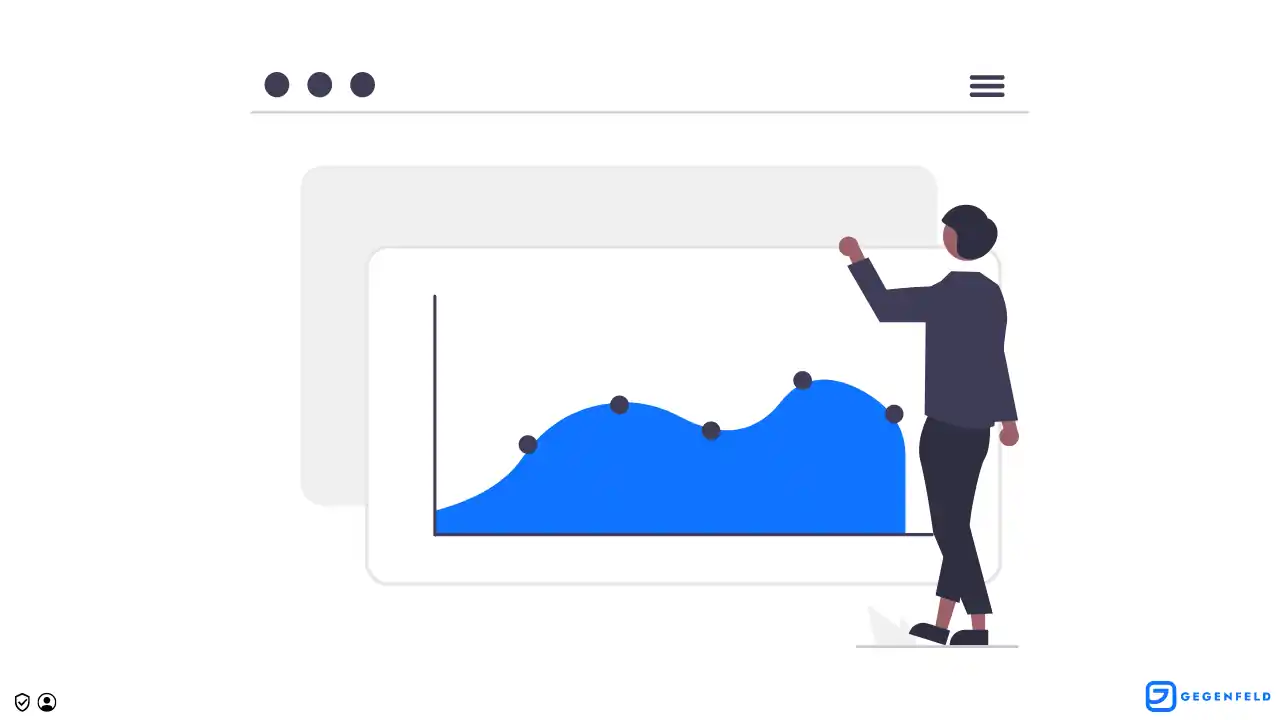
Pay attention to which snippets are displayed for which keywords. Google Snippets are small "information snippets" that display the content of a page in compressed form, standing out from the ordinary search results.
When conducting your keyword analysis, check which snippets appear in Google for the respective keyword. Many SEO tools display this in their reports. However, snippets can change quickly. Search for your keywords yourself and see whether and which snippets are shown to you.
Traffic Value
We've already mentioned it — traffic value. Your SEO efforts cost you a great deal of time, resources, and potentially money. For this to be worthwhile, you need to know the value of the traffic you receive through your work. The actual traffic value of a keyword depends on various factors:
Monthly search volume
Monthly clicks
Ad price
Search intent
SEO tools generally show you how much you would have to pay for the same traffic if you were running Google ads. While this can be a good basis for assessing the value of user traffic, it is not comprehensive.
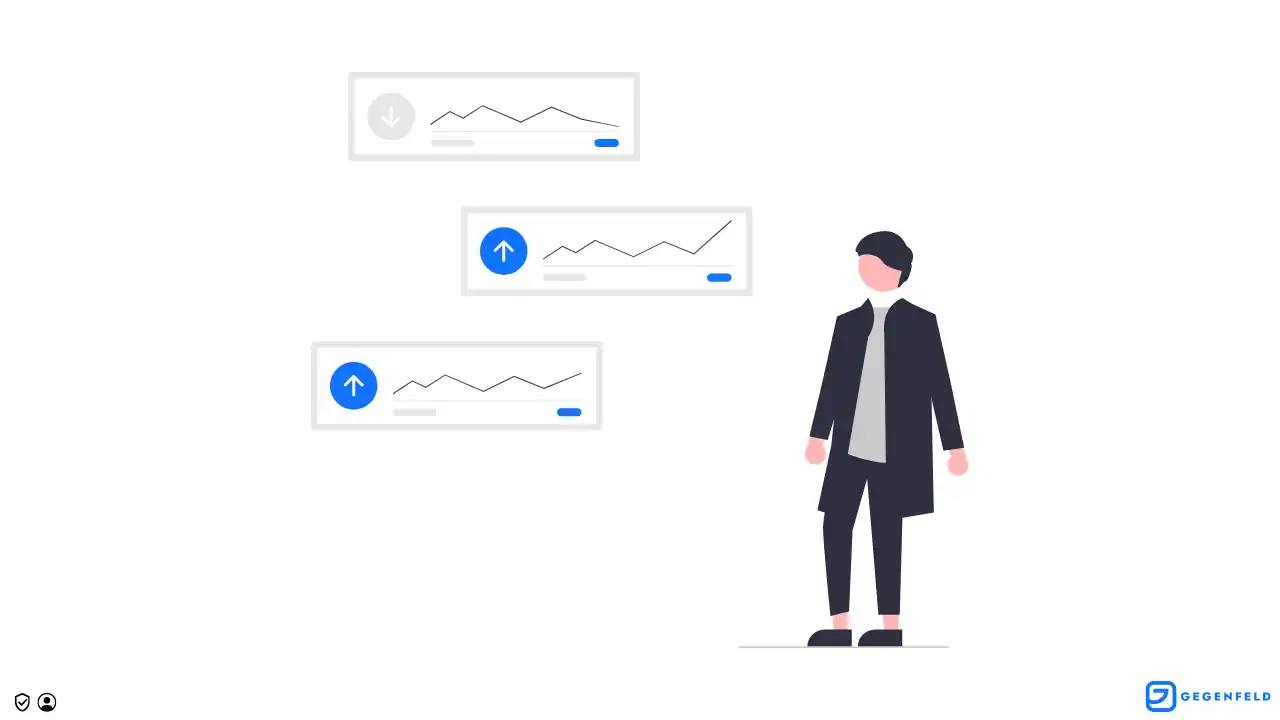
If your keyword has a commercial search intent, such as "buy women's trekking boots," you can expect a high ROI (return on investment) for your SEO efforts for every click.
Suppose you rank in position one for the keyword "buy women's trekking boots." The keyword has a monthly search volume of 480 and is worth four euros per click to you. As the top search result, you receive approximately 32% of the keyword's traffic.
Based on these figures, you receive a traffic value of 480 × 0.32 × €4 = €614.40.
As long as you spend less than €614.40 per month to maintain your top ranking for the keyword "buy women's trekking boots" — which is very likely — you are generating a profit.
Therefore, think very carefully about whether it is worth ranking for keywords with high search volume but low traffic value, or whether you would rather target long-tail keywords with a high traffic value.
Keyword Difficulty
You'll realize it at the latest when you publish your content — ranking for popular keywords is not easy. Be sure to analyze how difficult it will be for Google to suggest you for a specific keyword.
Since, for example, "trekking boots" is a sought-after keyword where established brands already rank, as a newcomer we would have to invest significantly more time, money, and effort than our competition — and even then, a ranking would not be guaranteed.
It is easier to cover many relevant long-tail keywords with weak competition. The traffic from dozens of small keywords adds up and helps us gain a foothold even in competitive niches.
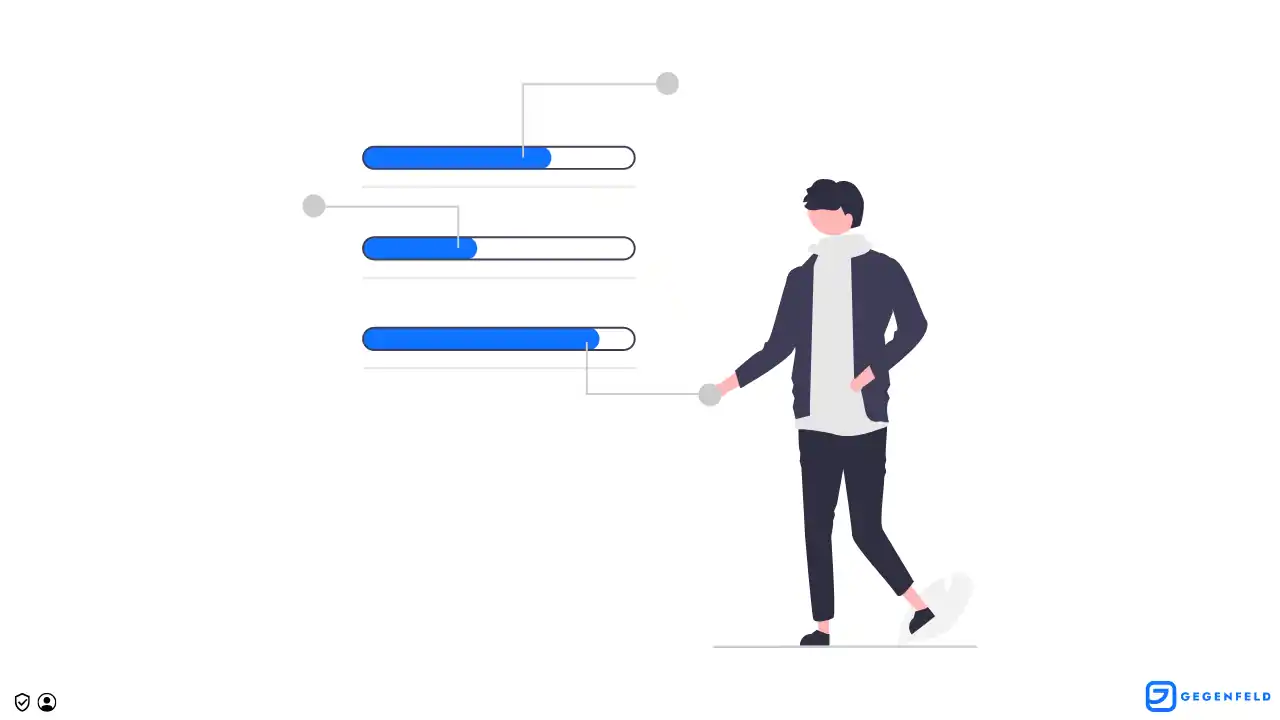
But how can keyword difficulty be determined? Most SEO tools show you a value from 0 to 100 representing the KD for a keyword. The higher the number, the more difficult it will be to rank for that keyword — the key term here is barriers to entry.
If your tool doesn't determine a KD, you can also assess it manually. Take a look at the following three attributes.
Domain Rating and URL Rating (Backlinks)
Domain rating is a value that indicates the strength of a web address. When a domain receives backlinks, its domain rating generally rises. The higher it is, the more Google and other search engines trust the website.
If your website has a high DR, you can usually rank new content in the search results more easily and quickly — but so can your competitors. Make sure you can keep up with your competition.
To do this, inspect the backlink profile of the first ten, and especially the first three, search results for your keyword. How many backlinks has the specific URL and the overall domain received? How high-quality are the backlinks — do they come from reputable websites, well-known names in the niche, are they links with a "nofollow" attribute or not? The following scenarios represent a weak DR:
Few to no backlinks to the domain
Few to no backlinks to the exact URL
Backlinks come from disreputable sites
Backlinks come from sites with a weak DR
Backlinks were marked with the "nofollow" link attribute
If several of the above criteria apply, consider yourself lucky — your competition knows nothing about SEO or is just as much at the beginning as you are. Note whether the first three search results for your keyword have a weak DR.
If so, that's a good sign for you. But domain rating alone is not sufficient to determine the success of your keyword research.
Google E-E-A-T Update
The algorithm update "Google E-E-A-T" made clear what Google wants. To achieve optimal rankings, you must demonstrate Expertise, Authority, and Trustworthiness.
You can benefit enormously from Google E-E-A-T if you meet the criteria, because many large websites fail on the point of "Expertise" since they are not focused on one specific niche.
You may be wondering how you can meet the E-E-A-T criteria. It's quite straightforward:
Create technically excellent content on your topic
Obtain backlinks from authorities in your niche
Become recognized publicly
Through the E-A-T algorithm, Google evaluates your brand strength. This ensures that only high-quality content, especially on sensitive topics, is displayed.
Make sure you meet the E-A-T criteria to increase your ranking chances for your keyword. Also check whether your competition meets those criteria.
Competition in the SERPs
This point logically follows from the factors mentioned above regarding keyword difficulty. The weaker your competitors, the higher your chance of reaching a top position in the SERPs.
Study your competition and assess their content quality, DR, and E-A-T compliance. If you find that the other search results are superior to yours in several areas, that's a sign to change the keyword.
Your content may be able to surpass your competitors in terms of substance, but if Google does not consider you credible, you will not rank — especially against strong competitors.
Creating a Keyword Plan
You've analyzed your keywords, added notes, and filtered them. Now it's time to create a keyword plan. The plan helps you group keywords and prepare them for your SEO campaign.
Ideally, set up an Excel spreadsheet or a Notion document in which to develop the keyword plan. Let's start with segmentation.
Keywords by Search Intent
The most important group first — search intents. During your keyword analysis, you determined what intention a user is pursuing with their search.
Create a group/variable in your document with three parameters:
Informational
Transactional
Navigational
Then assign the appropriate search intent to all keywords in your list. If you're not sure which search intent fits a keyword, re-read the search intents section and transfer your analysis results into your keyword plan.
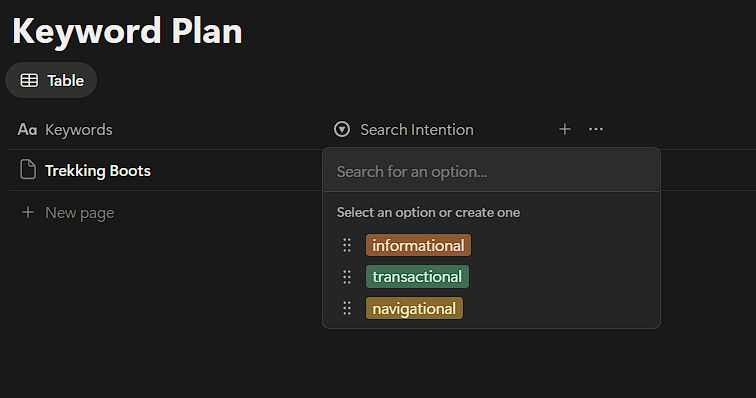
Tip: Separate the individual search intents with different colors. This helps you maintain an overview. You can also assign individual color codes to the other groups or variables.
Keywords by Topic
Next, assign topics to your keywords. The term "topic" can be replaced with another term depending on the situation. In our example, the term could also be "product," and an individual topic might be "women's trekking boots."
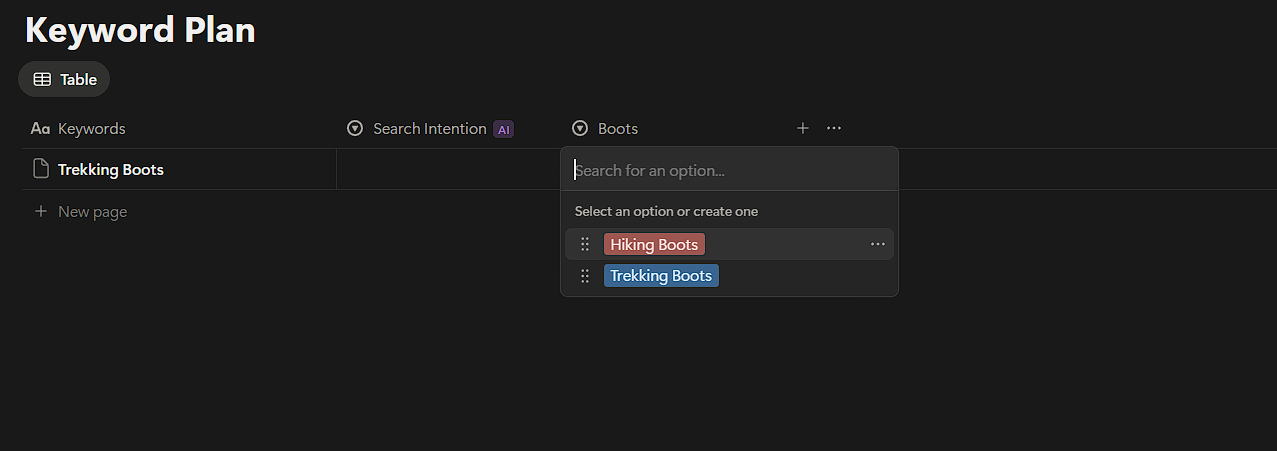
Ultimately, you want to categorize which topic each keyword addresses. This is primarily relevant for large websites. The more niche-focused your site is, the more you can afford to skip this step.
Keywords by Content Type
Keywords are usually tied to a content type. That means a specific form of content performs significantly better for a keyword than others. Which type of content that is can be identified in the SERPs.
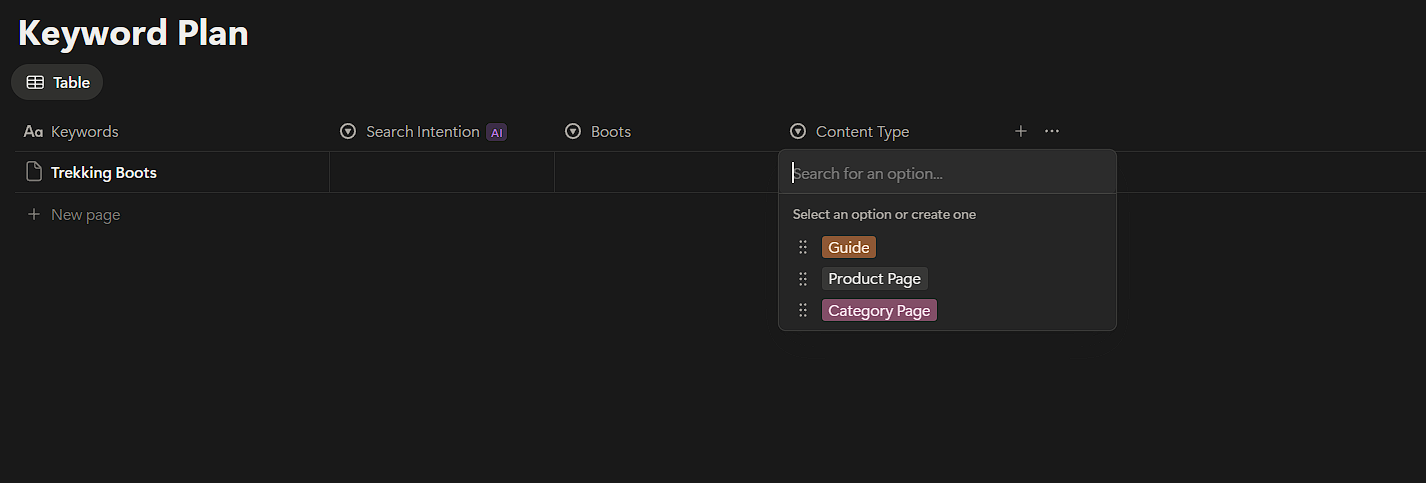
Record in your keyword plan which content type ranked first in the SERPs for each keyword. Common content formats include:
Guides
Guides are a very widespread content format and generally serve an informational search intent. People who read guides are often in the first or second phase of the customer journey.
However, not all guides are the same — there are how-to guides (like the one you're reading now), comprehensive tutorials, extended explanations of terms, and much more, all of which differ from one another.
It's up to you how much granularity to include in your keyword plan. We recommend being as specific as possible, however, to work more efficiently when creating content and handling on-page SEO.
You can even be more specific and note which content elements are required for which content type. For a guide on the topic of "trekking boots," for example, these might include:
W-questions and answers / FAQ
Summary
Term explanations
Lists
Tables
Infographics
Images
Collecting this information will enormously help you and your team during content creation.
Product Pages
Product pages are frequently shown for keywords with a transactional search intent. Users searching for such keywords are usually near the end of the customer journey — meaning there is purchase intent.
In addition to classic product pages, there are also service pages, pricing pages, and similar performance-related pages.
There are many ways to build product pages. Take inspiration from what works. Rely on familiar elements and building blocks such as:
High-quality product images
Product/service description
Product information
Delivery information
Product FAQ
Trust badges
Tables
Infographics
The building blocks aren't directly relevant to your keyword plan, but you can make a side note assigning the building blocks to the content types of your keywords.
Category Pages
Category pages are essential for medium to large online shops, marketplaces, and similar sites. You'll find that many of your competitors (online shops) predominantly rank category pages for keywords.
Note exactly which keywords your competitors' category pages are ranking for. Keep in mind that you generally need to match your competitor's offering in order to rank.
Types of Keywords
The types of keywords you use are crucial to the success of your SEO campaign. For beginners without a large website, LTKs are practical, as the chances of ranking are higher due to lower competition.
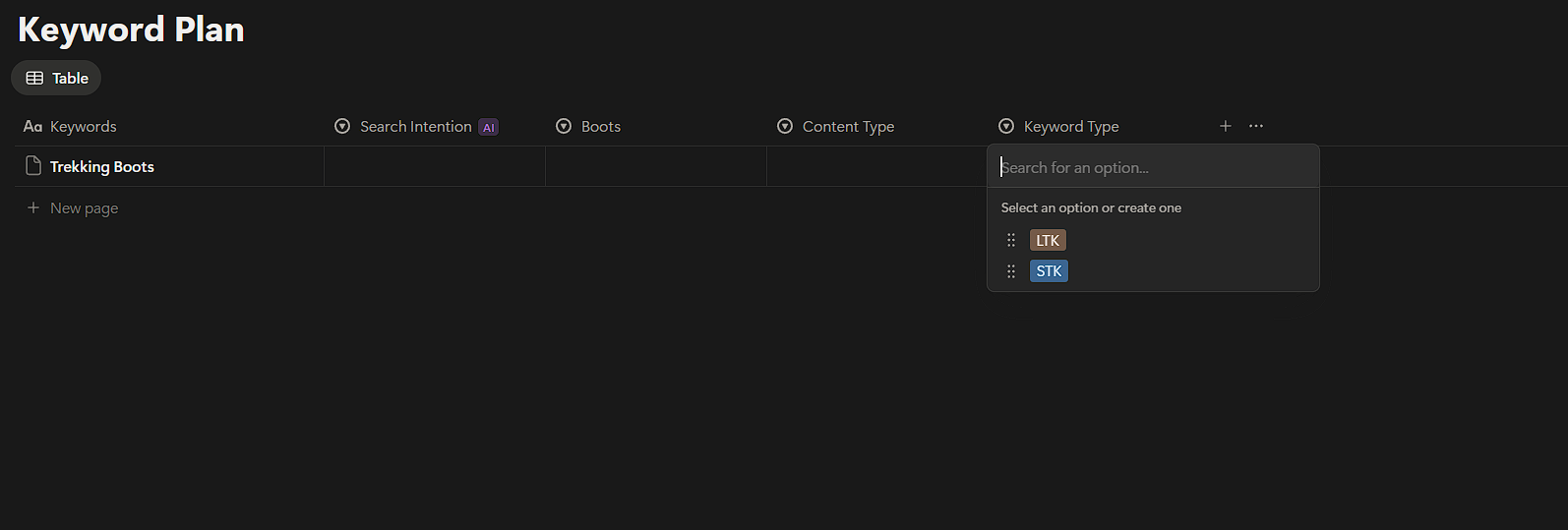
Categorize the keywords within your keyword plan by keyword type. Also add the estimated search volume.
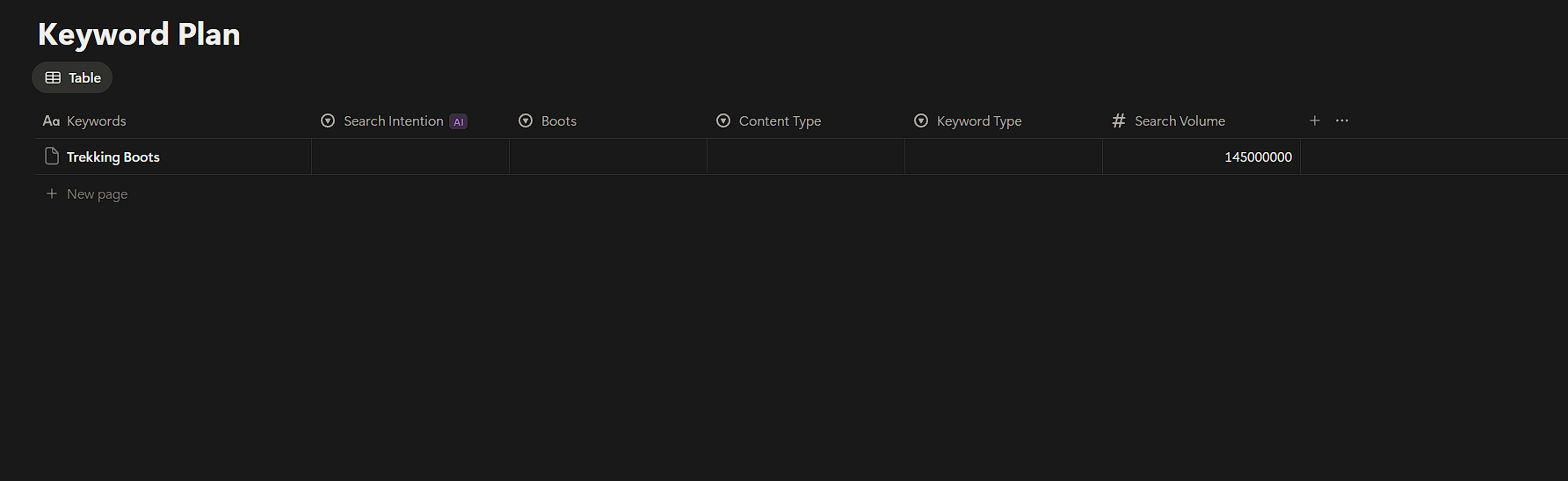
Short-Tail Keywords
Keywords that have relatively high search volume compared to the niche average are generally classified as short-tail keywords. Keywords marked as STKs tend to be more competitive and are less well-suited for beginners.
Long-Tail Keywords
Keywords that have relatively low search volume compared to the niche average are generally classified as long-tail keywords. Keywords marked as LTKs are less competitive and more suitable for beginners.
Keywords by URL
Your site must be well-structured. Consequently, even during keyword research and planning, pay attention to the URLs/pages that will be created and optimized for a keyword. Enter the relevant URLs for each keyword in your keyword plan. This helps you keep track of which pages you need to create or adjust.
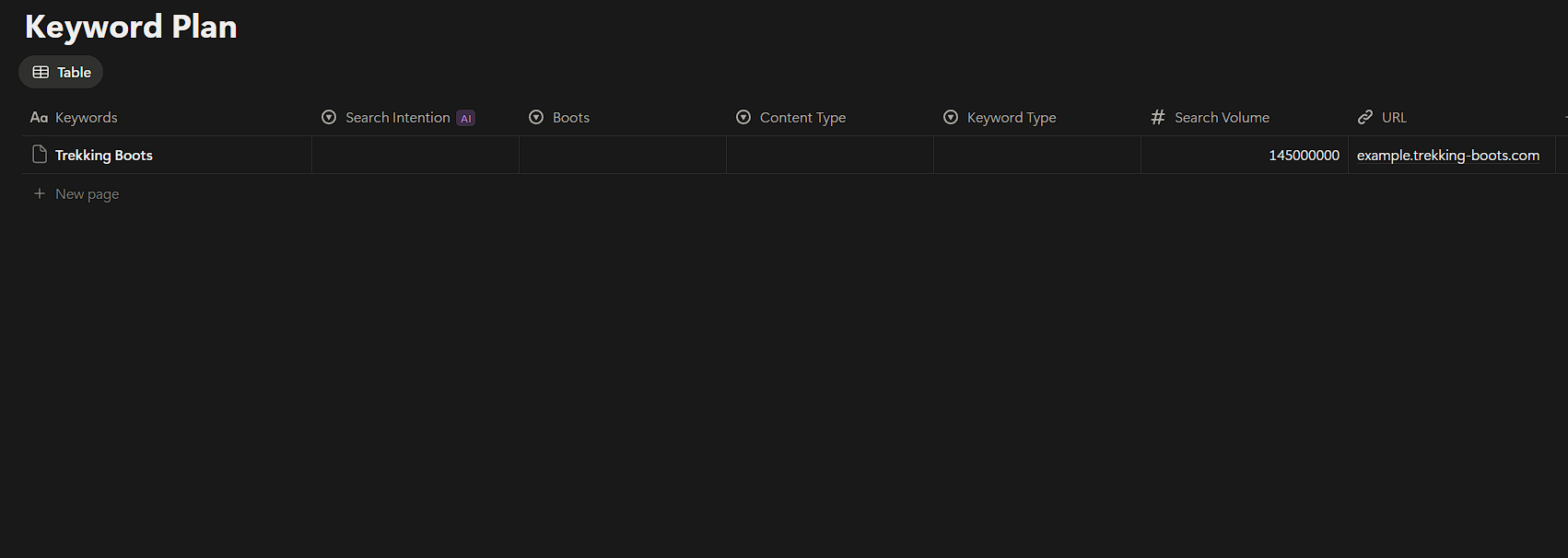
Of course, there are keywords that don't require their own page but can be covered under a general page. What to do in that case is explained now.
SERP Overlap Score
The SERP overlap score determines how similar the search results are for different keywords. It can happen that two different keywords share the exact same search intent.
If the exact same URLs/pages rank in the search results for two keywords — for example, "buy women's trekking boots" and "women's trekking boots to buy" — there is a high SOC (SERP overlap score).
To avoid keyword cannibalization, you should create only one page for all keywords that have a high SOC — or merge existing individual pages for the respective keywords into one.
Definition
Keyword cannibalization in SEO describes the situation where two pages from the same domain compete against each other for the same keyword in the SERPs.
In your keyword plan, make a note that a high SOC exists between the relevant keywords. Also add a field for the URL to be used for the respective keywords — as shown previously.
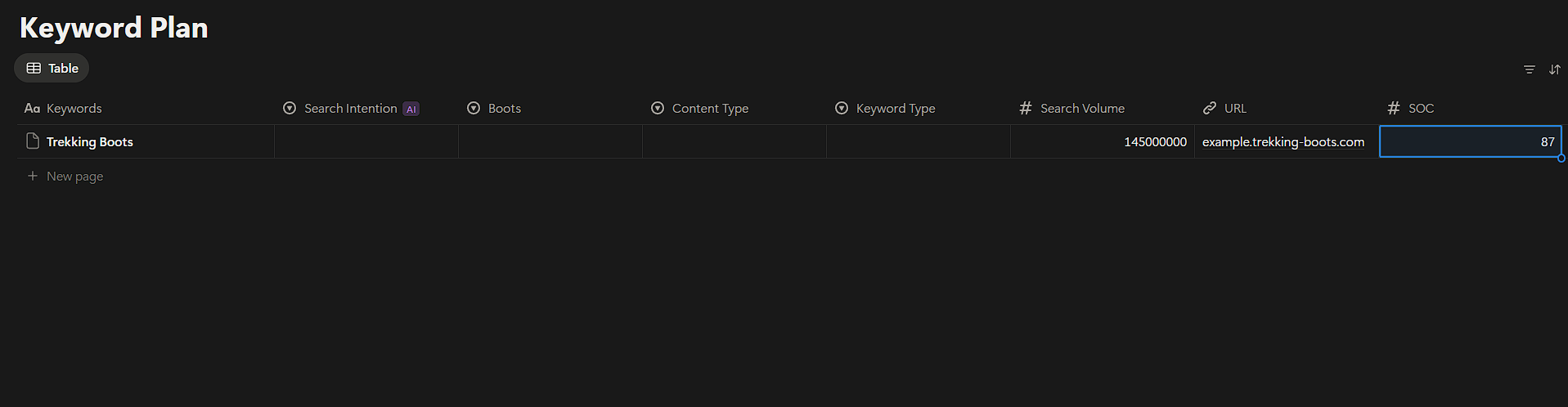
You have now incorporated the most important elements into your keyword plan.
Prioritizing Keywords
Your keyword plan is complete and you have a large selection of good keywords with associated data — so what's next? You prioritize the keywords for your SEO campaign.

There are various prioritization approaches — in this guide we take a revenue-growth approach. That means we focus first on keywords with a high monetary value, close to the purchasing event.
Keyword Position in the Funnel
Behind every search query lies a user's intent — you know that by now. You benefit from this by sorting your keywords according to their position in the sales funnel/customer journey. A funnel is structured so that the wide opening captures a broad mass of users, and a small, more "concentrated" group of users emerges from the narrow end.

This small group of users consists of people who are about to make a purchase or are already in the buying process. By assigning keywords to their proximity to one of the two openings in the funnel, you determine which users you are targeting — people who just want to gather information or those who are ready to buy immediately.
Focus on Commercial Keywords (BOTF)
Focus first on commercial keywords. These are keywords with a transactional search intent. Users searching for these terms are usually close to making a purchase.
To make your SEO efforts profitable more quickly and sustainable from a business perspective, we recommend focusing on keywords at the so-called "Bottom of the Funnel." Product, service, or category pages frequently rank for commercial keywords.
In our example, this means we want to cover the keyword "buy women's trekking boots" first, before creating content for the keyword "how to waterproof trekking boots."
Only after covering the keywords at the BOTF do we recommend moving on to the next step in your SEO campaign.
Covering Relevant Questions (MOTF)
The earlier a potential customer comes into contact with you, the more likely they are to choose your offer when making a purchase.
To create natural touchpoints with your target audience, it is worthwhile to cover relevant questions. This includes keywords with an informational search intent. Use guides and similar content to address important questions in your niche.

In addition to the fact that high-quality guides on topically relevant keywords boost your expertise and trustworthiness, they subconsciously register with users. Furthermore, informational content allows you to reach more people, as these keywords generally have higher search volume.
When a user is then faced with a purchasing decision and has the choice between you and competitor XYZ, they will predominantly choose you. The reason — your useful content appearing early in the customer journey makes you feel familiar to the eventual buyer.
Becoming the Go-To Source on a Topic (TOTF)
Achieving a monopoly — or at least an oligopoly position — on a topic is difficult, though very profitable. For beginners, we recommend removing general keywords from your priority list.
The reason is the high level of competition that exists around general short-tail keywords. With a new website, it is nearly impossible to rank for STKs like "trekking boots" or "shoes."
An important indicator of whether "Top of the Funnel" keywords are worth pursuing is keyword difficulty.
Monetary Value of Traffic
Why are you working on SEO? Generally speaking, you want to grow your business's revenue over the long term. What matters most is the value of the traffic — that is, individual visitors — to your website. Since your visitors are drawn in by search queries, and search queries are made up of keywords, you can measure the value of a keyword (its traffic).
Less Traffic, More Revenue
It sounds absurd, but it's partly true. Not all traffic is worth the same — that much is logical.
Keywords that sit at the BOTF and generally have a transactional search intent typically receive less traffic, but traffic that is more valuable. The reason — those searching have the intent to carry out a transaction.
If you receive 500 visitors through the keyword "buy women's trekking boots," they are often worth more than 10,000 visitors who land on your website via the keyword "what are trekking boots." Always be aware of the relative value of your traffic.
Written by
Gegenfeld Team
Gegenfeld Team