

Affiliate Marketing: Start in 7 Steps – Beginner's Guide
Are you interested in entering the lucrative world of affiliate marketing? This guide provides you with a straightforward starter plan.
What is Affiliate Marketing?
Affiliate marketing is an online marketing strategy in which companies have their products promoted by partners (affiliates). Affiliates earn commissions for generated sales, clicks, or leads. This win-win partnership allows companies to increase their reach while affiliates generate income.
How Do You Start with Affiliate Marketing?
This guide shows you in seven steps how to start with affiliate marketing:
Decide on a platform
— Carefully select the platform/advertising channel on which you want to run your affiliate marketing.
Choose your niche
— Wisely choose your niche by identifying a specific and focused target audience to direct your affiliate marketing efforts.
Find a lucrative affiliate program
— Identify a profitable affiliate program through thorough research, taking into account commissions, products, and the reputation of the merchant to ensure long-term success in affiliate marketing.
Create converting content
— Generate impactful content by providing high-quality information and specifically addressing the needs of your target audience to successfully generate conversions via your affiliate link.
Market your affiliate website
— Market your affiliate website effectively through search engine optimization (SEO), social media promotion, and targeted advertising measures to increase visibility and drive more traffic to your affiliate content.
Promote your affiliate link
— Promote your affiliate link through targeted email marketing, social media campaigns, and integration into relevant content to maximize reach and motivate potential customers to interact and convert.
Generate sales
— Maximize sales through targeted conversion optimization, attractive offers, retargeting, email marketing, and excellent customer service for successful closings.
These 7 steps will get you started with affiliate marketing. Our beginner's guide shows you the way, from affiliate programs to strategies.
Important Definitions
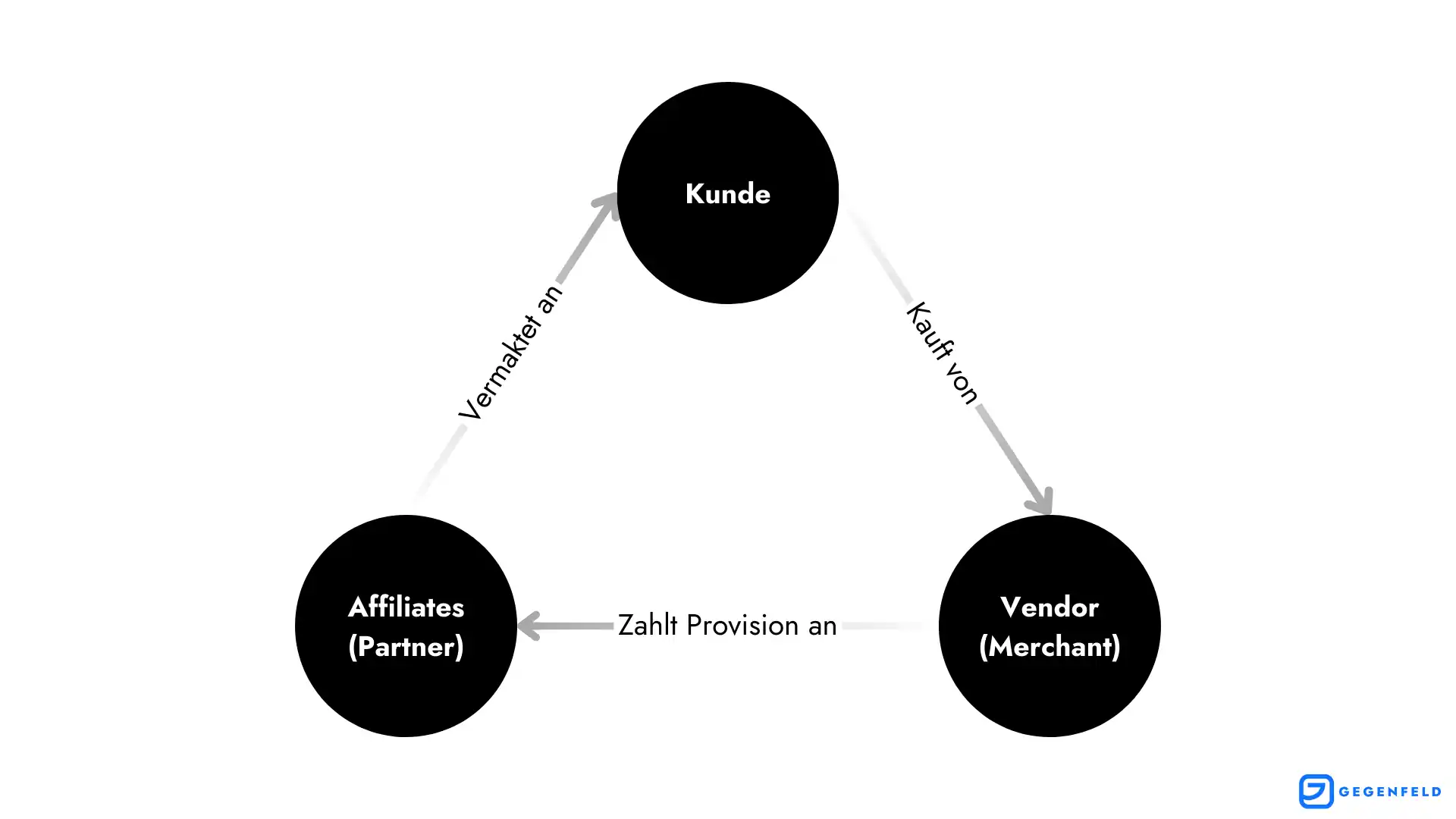
In affiliate marketing there are various terms that we want to clarify upfront to avoid confusion. The first word may already be familiar to you.
Affiliates
Affiliates, often also called publishers or partners, are people who promote products and services of companies through their own channels and earn a commission in case of success.
Commission
The commission is a remuneration that affiliates receive for their efforts in affiliate marketing. This remuneration is usually calculated based on certain actions such as sales, clicks, or leads and serves as payment for the successful marketing of the vendor's offerings.
Vendor
A vendor, also called merchant, dealer, or advertiser, is a company that offers products or services and works together with partners (affiliates) within the framework of affiliate marketing. The vendor provides marketing materials and compensates affiliates based on predefined conditions for successful actions such as sales, clicks, or leads.
How Does Affiliate Marketing Work?
In affiliate marketing, each partner receives a unique link from the merchant to track the origin of sales. When someone clicks on this link, a so-called "cookie" is stored on the user's device. The affiliate cookie serves two main purposes:
Tracking:
It allows the vendor to attribute the sale to the correct affiliate.
Time span:
Cookies are often valid for a long time, so partners are also paid in case of delayed purchases.
Here is an example with explanation:
Suppose a reader visits your blog post about the best programming courses and clicks on one of your affiliate links leading to a programming course on Gegenfeld. But suddenly he interrupts his purchase because the doorbell rang. The reader forgets what he was doing and only returns to Gegenfeld the next day, but decides to purchase Gegenfeld Pro to learn programming. Since he previously clicked on your affiliate link, the cookie remains stored on his device.
How Do I Earn Money with Affiliate Marketing?
As an affiliate, you promote the merchant's products or services on your platform, whether that is a website, a blog, or on social media. You receive a unique affiliate link that makes it possible to track the traffic and sales generated through your recommendations.
Remuneration is generally on a commission basis — meaning you earn a commission for every sale, lead, or transaction brokered through your link. The commission is either a fixed monetary amount or is calculated as a percentage based on the order value. Here is an example:
Fixed monetary amount:
€10 per sale
Percentage share:
25% of the order value
However, there is a problem — many affiliate programs offer exclusively one-time payments. This means that for every new commission you also have to recruit a new customer. This leads to the following disadvantages:
Poor predictability
High advertising costs
Uncertain income
The solution is recurring commissions, particularly through subscriptions, as these offer you several advantages compared to one-time payments:
Stability and Continuity
Recurring commissions provide a more stable source of income, as you are not dependent solely on individual transactions. This creates a longer-term and continuous source of income, which means financial stability for affiliates.
Long-term Customer Retention
Subscriptions mean that customers pay regularly for the service or product. Through continued use, they build a relationship with the product or service, which increases the likelihood that they will remain customers over a longer period.
Higher Income in the Long Run
While one-time commissions are limited to a single sale, recurring payments can lead to significantly higher income over time. The cumulative effect of multiple subscription payments can be very profitable in the long run.
Reduction of Acquisition Effort
Acquiring new customers is often more cost-intensive than retaining existing ones. With recurring commissions, it is possible to focus on the long-term relationship with customers and reduce acquisition effort.
Scalability
Recurring commissions offer better scalability for affiliates. The continuous generation of income makes it possible to invest more time and resources in expanding the affiliate business.
Here is an example with explanation:
You market a programming course and are compensated with €10 per sale through your link, but you spend around €7 per customer on marketing. This means you only generate €3 profit per customer. In the traditional affiliate model with one-time payments, each new customer requires a new advertising campaign and you pay again for each customer.
Suppose you now switch to our affiliate program at Gegenfeld and receive 25% of the monthly subscription price for each customer who takes out a subscription through your link. The subscription costs (net) approximately €10.41 and a recruited customer remains an average paying user for 14 months. Consequently you receive €38.40 per customer. Minus your €7 advertising costs, that is a profit of €31.40 — increased by a factor of ten.
How Do I Get Started with Affiliate Marketing?
Getting started with affiliate marketing requires a structured approach.
Step 1: Decide on a Platform
The first step in affiliate marketing is deciding on a platform on which you want to promote your affiliate links. This platform can be varied and depends on your preferences, skills, and the type of content you want to create. Possible platforms include:
Website or blog:
Your own website or blog offers comprehensive control over your content. You can publish detailed information, reviews, and guides about the promoted products here.
YouTube channel:
With video content you can present products or services, create tutorials, and place your affiliate links in the video description.
Social media:
Platforms like Instagram, Twitter, or Facebook can be used to share affiliate links. Make sure that your content is engaging and relevant for your target audience.
Podcast:
If you enjoy speaking, you can create a podcast in which you talk about products or services and incorporate affiliate links.
Email marketing:
By building an email list you can regularly send affiliate products to your subscribers.
Decide on the platform that best suits your skills and preferences. Also consider your target audience and what type of content they prefer. Success in affiliate marketing often also depends on the effectiveness of your chosen platform.
Step 2: Choose Your Niche
The second step in affiliate marketing is choosing your niche. The niche represents the specific topic or industry on which you want to focus your affiliate marketing.
Choosing a clear niche is crucial, as this defines your target audience and allows you to specifically promote relevant products or services.
Interests and passions:
Consider which topics interest you or which you are passionate about. Working in a niche that appeals to you personally makes affiliate marketing more authentic and enjoyable.
Relevance and demand:
Check the relevance and demand in potential niches. Products or services that already have a certain level of demand are often easier to market.
Analyze competition:
Examine the competition in your potential niches. Too intense competition can make it difficult to establish yourself, while too small a target audience may not offer enough opportunities.
Profitability:
Consider the profitability of the niche. Think about whether there are affiliate programs that offer attractive commissions and whether your target audience is willing to pay for products or services in this niche.
Target audience analysis:
Understand your potential target audience. The better you understand their needs, problems, and interests, the more effectively you can recommend products or services to them.
Combination:
Prefer a niche that offers a balanced combination of your interests, high demand, and good earning potential. This makes it easier to create relevant content while also being successful in affiliate marketing.
By the way, as a Gegenfeld partner you have the advantage of being able to advertise across a wide variety of niches/topics, due to the high variety of our educational offerings, which appeal to different interest groups.
Step 3: Find a Lucrative Affiliate Program
The third step in affiliate marketing is choosing a good, reputable, and lucrative affiliate program. The quality of the affiliate program has a direct influence on your success as an affiliate. Here are some steps to find a suitable affiliate program:
Good product offering
Recurring commissions
Long cookie duration
Reputable company
Support for affiliates
Check tracking
Fair contract terms
Positive customer reviews
Research of products/services
Identify products or services that fit well with your chosen niche. Make sure that they are of high quality and offer genuine added value for your target audience.
Evaluation of commissions
Examine the commission structures of the affiliate programs. Take note of both fixed monetary amounts and percentage commissions. A balanced ratio between attractive commissions and realistic sales opportunities is crucial. If possible, choose recurring commissions.
Cookie duration
Pay attention to the cookie duration of the affiliate program. A longer cookie duration means that you can still earn commissions even if the customer makes a purchase after some time.
Reputation of the company
Work with reputable companies. Check the reputation of the merchant, their punctuality of payment, and whether they provide transparent reports.
Support and resources
Value the support and resources provided by the affiliate program. A good affiliate program offers you tools, resources, and support to optimize your affiliate activities.
Review of tracking mechanisms
Ensure that the affiliate program has reliable tracking mechanisms. Efficient tracking is crucial to ensure that you are correctly compensated for your brokered sales.
Contract terms
Read the contract terms carefully, particularly clauses on payments, termination, and liability. Clear and fair terms are important for a long-term partnership.
Reviews and feedback
Look for reviews and feedback from customers and other affiliates to get an insight into the experiences with the affiliate program.
Lucrative Affiliate Programs — Our Recommendation
This is at the same time an honest recommendation, self-promotion, and advice to the best of our knowledge and belief. We wholeheartedly recommend the Gegenfeld affiliate program to you. Why?
Excellent educational content
High customer satisfaction
Recurring 25% commission
180-day cookie duration
Secure payment dates
Competent partner support
High-quality advertising materials
Step 4: Create Converting Content
Creating converting content forms the foundation for a successful affiliate marketing strategy. It is not just about promoting products, but about delivering valuable information and gaining the trust of your target audience. Here are some detailed steps:
Target audience analysis:
Begin with a thorough analysis of your target audience. Understand their needs, challenges, and interests. This allows you to create targeted content that addresses their specific requirements.
Diversify content formats:
Experiment with different content formats to appeal to a wide range of users. These can be comprehensive reviews, detailed guides, product comparisons, or solutions for common problems in your niche.
SEO optimization:
Integrate relevant keywords into your content to improve findability in search engines. Through a targeted SEO strategy you increase the organic visibility of your content and reach a larger target audience.
Use storytelling:
Tell stories that are connected to your affiliate products. Stories evoke emotions and help build a personal connection with your target audience. Authenticity plays a key role in the persuasiveness of your content.
Subtle integration of affiliate links:
Place affiliate links at strategic points in your content, but without appearing intrusive. The integration should be natural and relevant so that your readers or viewers recognize the added value of your recommendations.
Provide added value:
The main focus should be on providing genuine added value. Deliver helpful information, tips, and advice. When your target audience feels that your recommendations are authentic and useful, the likelihood of them following your affiliate link increases.
Encourage interaction:
Create opportunities for interaction, whether through comments, feedback, or integration in social media. This strengthens the bond with your target audience and promotes the credibility of your recommendations.
By focusing on creating high-quality, targeted, and engaging content, you lay the foundation for a successful affiliate marketing strategy. This content forms not only the bridge to your affiliate link, but also the trust and loyalty of your target audience.
Step 5: Market Your Affiliate Website
The effective marketing of your affiliate website requires an intelligent combination of search engine optimization (SEO) and a strong presence on social media platforms. Here are detailed steps for this process:
Search Engine Optimization (SEO)
Keyword research:
Conduct thorough keyword research to identify relevant terms that are searched for by your target audience. Consider long-tail keywords to address more specific search queries.
Quality content:
Create high-quality, informative content that addresses the needs of your target audience. This content should not only contain keywords, but also provide clear added value.
On-page optimization:
Optimize your website for search engines by incorporating relevant keywords in meta tags, headings, and image descriptions. Ensure user-friendly navigation, fast loading times, and mobile optimization.
Internal and external links:
Set internal links to facilitate navigation on your website. External links to high-quality sources can strengthen the credibility of your website.
Regular updates:
Keep your content regularly updated and add new information. Search engines prefer current and relevant content.
Social Media Strategies
Platform selection:
Identify the social media platforms that best suit your target audience. This could be Facebook, Twitter/X, Instagram, LinkedIn, or other platforms.
Content adaptation:
Adapt your content to the respective platforms. Use visual content such as images or videos to attract attention.
Regular posts:
Share relevant posts and content regularly. Plan your posts to maintain a consistent presence.
Encourage interaction:
Encourage interactions through questions, surveys, or calls to participate. Active interaction promotes the reach of your posts.
Social media advertising:
Consider paid advertising measures on social media platforms to specifically increase your reach. Targeted ads can be effective in reaching your target audience.
Combination
The combination of SEO and social media creates a comprehensive online presence for your affiliate website. Visibility in search engines and active participation in social networks increase the chances that your affiliate content will be found and shared by your target audience.
Step 6: Promote Your Affiliate Link
After you have created high-quality content and optimized your website, it is now crucial to actively promote your affiliate link.
Use email marketing:
Integrate your affiliate link in targeted email campaigns. Create content that appeals to your target audience and share relevant product reviews, offers, or exclusive discounts. Personalize your emails and use clear call-to-action elements.
Deepen social media strategies:
Expand your social media presence through targeted advertising and organic posts. Develop a content strategy that highlights your affiliate products. Use hashtags and share your affiliate links on different platforms. Also use story features, surveys, and live videos for active interaction.
Live events and webinars:
Organize live events or webinars to interact directly with your target audience. Present products and services, integrate your affiliate link, and answer questions live. Use these opportunities to emphasize the advantages of the promoted products.
Guest posts and collaborations:
Write guest posts for high-quality websites or blogs in your niche. Integrate your affiliate link in a natural and valuable way. Collaborate with other influencers or content creators for joint actions or cross-promotions.
Paid advertising:
Consider paid advertising measures to specifically drive more traffic to your affiliate content. Experiment with different platforms such as TikTok Ads, Google Ads, or influencer marketing to increase the reach of your affiliate links.
Continuous content updates:
Maintain your content regularly by updating reviews, adding new information, and sharing relevant updates. Continuous updating not only strengthens the credibility of your content, but also gives you the opportunity to draw attention to your affiliate link again.
Website banners and pop-ups:
Integrate subtle banners or pop-ups on your website to specifically draw attention to current offers or products. Make sure that these do not appear intrusive, but rather improve the user experience and contain clear calls to action.
Community interaction:
Actively engage in relevant forums, groups, or online communities. Share your expertise, answer questions, and unobtrusively integrate your affiliate link where this is helpful and appropriate.
Targeted keywords in promotion:
Make sure to use targeted keywords in your promotion, both in your social media posts and in other promotions. This optimizes the findability of your affiliate content, particularly in organic search results.
Tracking and analysis:
Use advanced tracking tools to closely monitor the performance of your promoted links. Analyze incoming data to understand which promotion strategies are most effective. Adjust your approach accordingly to continuously achieve optimal results.
Implementation
Through the precise implementation of these comprehensive steps you create a versatile and effective promotion for your affiliate link. The key is to remain flexible, continuously analyze, and respond to the changing needs of your target audience in order to achieve sustainable success in affiliate marketing.
Step 7: Generate Sales
After you have successfully promoted your affiliate link, it is now time to focus on the actual sales. Here are detailed steps to achieve concrete sales results.
Conversion optimization of the website:
Ensure that your website or landing page is optimally aligned for conversions. Reduce distractions, optimize the checkout process, and use clear call-to-action elements to turn visitors into buyers.
Offer optimization:
Review your promoted offers and products. Consider whether special discounts, time-limited promotions, or exclusive bonuses can increase the incentive to buy. An attractive value proposition can increase the likelihood of a sale.
Retargeting campaigns:
Implement retargeting campaigns to re-engage visitors who have left your website. Use targeted ads that highlight the promoted products to bring interested parties back and encourage closing.
Email marketing for closing sales:
Use targeted email marketing to convince potential customers. Use emails to provide additional information, answer questions, or offer exclusive deals. Clearly integrate your affiliate link in the process.
Live demonstrations or webinars:
Offer live demonstrations or webinars to present the functionalities of the promoted products. This allows potential customers to see the product in action and facilitates the purchase decision.
Customer reviews and testimonials:
Integrate customer reviews and testimonials on your website. Authentic experiences of other customers create trust and can positively influence the closing of sales.
Customer service and support:
Offer excellent customer service and support. Clarify open questions, respond quickly to inquiries, and ensure that potential customers receive the necessary support to make their purchase decision.
A/B testing for optimization:
Use A/B testing to optimize various elements of your website or sales strategy. Test different call-to-action elements, colors, texts, or offer structures to increase effectiveness.
Cooperations and joint ventures:
Consider cooperations or joint ventures with other brands or influencers. Joint actions can increase reach and strengthen the trust of potential customers.
Create sales-promoting content:
Create special content that supports the sales process. These include detailed guides, case studies, or comparisons that emphasize the advantages of the promoted products.
Implementation
Through the implementation of these comprehensive strategies you can work in a targeted way towards closing sales. Continuous analyses and adjustments to the needs of your target audience are crucial to maximize the effectiveness of your sales strategies.
Written by
Gegenfeld Team
Gegenfeld Team